
Written by Waterlog
There have been pages and pages written about the centrepin, the pros and cons, the mystic, do and don’ts. But I shall do my best and try and explain the centrepin in my own words along with my thoughts and reflections for those of you who are interested, or even maybe thinking of owning and fishing with such a reel. I’ve tried to keep the article as simple and straight forward due largely to fact its written in the most part for interested anglers here in Sweden..
It came to my surprise that the centrepin reel had not caught on in Sweden; after all many aspects of angling have started to creep over from the UK. But I must add the centrepin is by no means just a reel exclusively used by the English they crop up all over the world in one form or another, take Canadian and North American salmon anglers, there’s real parallel universe of the centrepin reel there, often in totally different formats to the classic English pins, but same mechanics at the end of the day! A rotating drum on a spindle, the most pure form of fishing reel, and one of the most affective for many of anglings situations.
Well as English pins go, there are two main formats, either Arial style, that have spoke drums, like a bicycle wheel. And then there’s the non Arial Style, which often look far more modern, and have a flat often drilled out ventilated drum. Both come in either wide drum or narrow drum, that’s spool width as rule the heavier the application and thicker the line diameter the wider the drum. They range from just over ½ inch to around 1½ inch in diameter.
There are two types of bearing to choose from these days, there has been a lot of discussion about which is best. You have ball races that you find in most modern reels. And then the true pin, that revolves around a single polished stainless steal or phosphor bronze ball, I’ve only ever used a ball raced pin, but ive just recently invested in a true pin, so I can give you my verdict after next summer maybe!
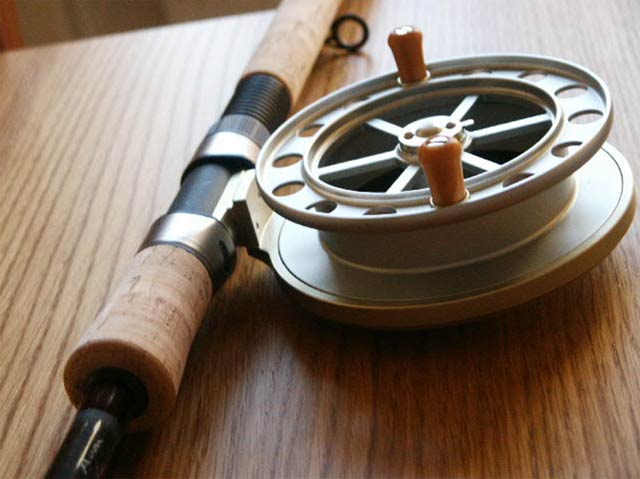
A true pin from Greys called the “Bewick” It’s extremely light and best suited to trotting or lighter still water fishing, and possibly less strenuous carp and tench tasks.
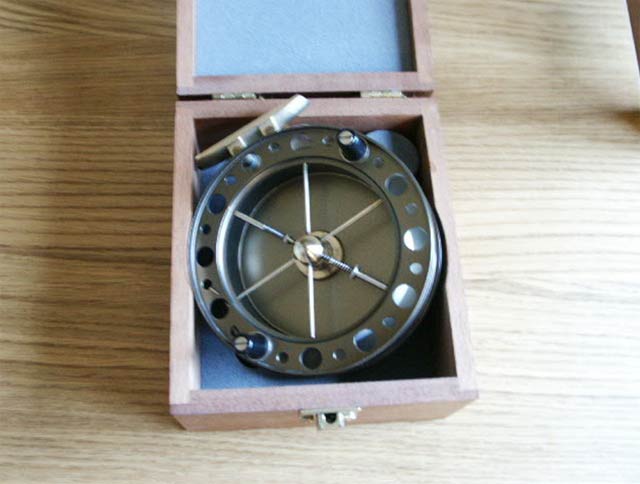
Here’s a JW Young’s and Sons Purist 2051 ball raced classic Arial style pin, Its more twice the weight of the Bewick, and due to its over all strength and wide drum is suited to some heavier tasks, stalking large carp tench or barbel, the perfect tool for stopping large fish when fishing tight against snags or any where else where direct control is needed.
So why did I start using a centrepin, well they have always been around in tackle shops glass cabinets, or you would some times see them being used by older anglers skilfully trotting for chub and dace on a local river. But John Wilson really got me fascinated, from as long as I can remember he’s been catching most fish species on the centrepin on his TV program in England “Go Fishing“, but what pushed me over the edge, and made me part with over £200 of hard earned cash, was watching Bob James and Chris Yates series of films ”A Passion For Angling” Any one who has watched Bob and Chris weld such fine and beautiful reels, just cant help but be drawn to that style of angling!
Over the years I’ve tried many different styles of casting, the most talked about casting style with a centrepin is the Wallis cast, I’ve not really managed it with constant success with the Purist due to its weight combined with the diameter of line needed for carp fishing or other heavy tasks. The Wallis cast involves perfect timing, as you release the tackle to cast, you set the drum spinning simultaneously giving line as the float or leger goes thru the air, then braking its flight with your thumb. Sounds easy? It can be a painfully hard leaning curve; these reels have no mechanical brakes or magnets their extremely free running and really take some taming to master, especially in windy conditions Unless you opt for an easier approach of pulling loops of line from the first four rod rings, and then as you cast your tackle simultaneously let the loops of line go.
Applications? There are many, but I favour the most common, trotting a float or freeline/touch legering in running water, for which the centrepin reel is unsurpassed in my opinion, within the boundaries of smaller rivers of course. And of course the margins of eddies of larger rivers. Close range Stillwater with static baits both float and freeline, there does not exist a better tool for the job! The Irish use them for a lot of there pike fishing, trolling or trotting live and dead bait, Ive not yet tried it myself, maybe give it a go in the future.
My final words are once you have had a fish of reasonable size take line from you, using a centrepin, the scream of the racket the warm thumb against the spool, total direct contact with leviathan, quite possibly you wont want to use any other reel ever again!
William Wyatt.
Uppdate 2nd June 2006. Since writing this I have found what I consider to be the ultimate mono for carp fishing or heavy tasks combining Wallis casting, I use 10lb Kystonite from Kyston, its truly amazing stuff. Very supple and comes of the drum in almost a straight line. Plus its almost invisible in water! Just wonderful!
Since writing the article I’ve unfortunately picked up on few shortcomings on the Bewick reel, which I’ve since sold.
One of the handles made grating noise; this was not acceptable on a reel of £200, or any reel for that matter. So after a short conversation with Hardys, makers of the reel, on behalf of Greys) they told me it was some left over super glue in side the handle, and that they would send me a new placement handle straight away. To Hardys credit a new handle arrived in two days from England. Only trouble was it was mustard coloured. Not at all like the bone coloured handles on my reel. So on the phone to Hardys again. Full of apologies and another mustard handle duly arrived in two days, with instructions how to super glue it place. Alarm bells are ringing now, mainly due to the fact the very thin handle screw only goes into the reels spool a few millimetres and is then held in place by glue! Then to add injury to insult on most reels you have an equal amount of ventilation holes drilled thru the spool, regardless of the handles being fitted or not. As some angler prefer not use the handles. And choose to bat the side of the spool to retrieve line. Any to my horror they had just made know effort to keep the reel symmetrical if used without handles.
There where to vent holes missing, and in there place two minuet drilled and tapped holes that looked cheap and ugly.
Another short coming was the reel had a far amount of play, the spool was able to move a far degree up and down, with out means of adjustment. I like to be able to set the amount of play myself. The Young’s reels have a small grub screw in the centre of the spindle to allow for adjustment that I find far more satisfactory.
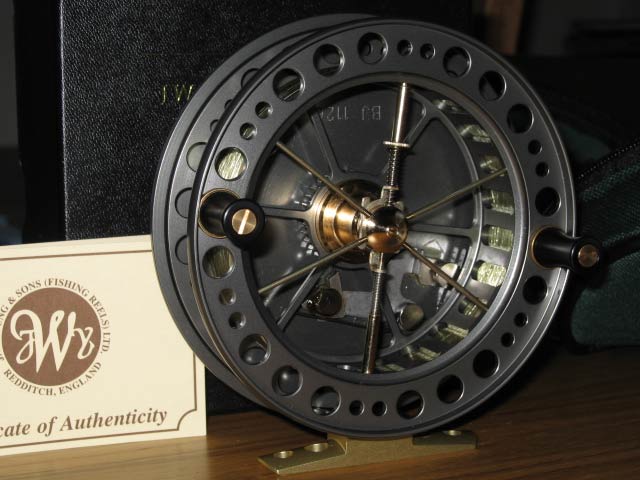
I’ve now invested in a new J.W. Young’s Bob James Y2080 centrepin pictured below, that I hope will be a happy medium. The strength of the purist but a little lighter and more comfortable on the rod hopefuly.
William.
Uppdate! The BJ Y2080 has been a success, due largely to the Kystonite fishing line, because the reel doesn’t really feel that different to the purist. Having said that I do like the lever check much better than the button check, plus the out going racket is double as loud as the in coming! Nice reel, but I don’t know if I remain monogamous!
There have been pages and pages written about the centrepin, the pros and cons, the mystic, do and don’ts. But I shall do my best and try and explain the centrepin in my own words along with my thoughts and reflections for those of you who are interested, or even maybe thinking of owning and fishing with such a reel. I’ve tried to keep the article as simple and straight forward due largely to fact its written in the most part for interested anglers here in Sweden..
It came to my surprise that the centrepin reel had not caught on in Sweden; after all many aspects of angling have started to creep over from the UK. But I must add the centrepin is by no means just a reel exclusively used by the English they crop up all over the world in one form or another, take Canadian and North American salmon anglers, there’s real parallel universe of the centrepin reel there, often in totally different formats to the classic English pins, but same mechanics at the end of the day! A rotating drum on a spindle, the most pure form of fishing reel, and one of the most affective for many of anglings situations.
Well as English pins go, there are two main formats, either Arial style, that have spoke drums, like a bicycle wheel. And then there’s the non Arial Style, which often look far more modern, and have a flat often drilled out ventilated drum. Both come in either wide drum or narrow drum, that’s spool width as rule the heavier the application and thicker the line diameter the wider the drum. They range from just over ½ inch to around 1½ inch in diameter.
There are two types of bearing to choose from these days, there has been a lot of discussion about which is best. You have ball races that you find in most modern reels. And then the true pin, that revolves around a single polished stainless steal or phosphor bronze ball, I’ve only ever used a ball raced pin, but ive just recently invested in a true pin, so I can give you my verdict after next summer maybe!
A true pin from Greys called the “Bewick” It’s extremely light and best suited to trotting or lighter still water fishing, and possibly less strenuous carp and tench tasks.
Here’s a JW Young’s and Sons Purist 2051 ball raced classic Arial style pin, Its more twice the weight of the Bewick, and due to its over all strength and wide drum is suited to some heavier tasks, stalking large carp tench or barbel, the perfect tool for stopping large fish when fishing tight against snags or any where else where direct control is needed.
So why did I start using a centrepin, well they have always been around in tackle shops glass cabinets, or you would some times see them being used by older anglers skilfully trotting for chub and dace on a local river. But John Wilson really got me fascinated, from as long as I can remember he’s been catching most fish species on the centrepin on his TV program in England “Go Fishing“, but what pushed me over the edge, and made me part with over £200 of hard earned cash, was watching Bob James and Chris Yates series of films ”A Passion For Angling” Any one who has watched Bob and Chris weld such fine and beautiful reels, just cant help but be drawn to that style of angling!
Over the years I’ve tried many different styles of casting, the most talked about casting style with a centrepin is the Wallis cast, I’ve not really managed it with constant success with the Purist due to its weight combined with the diameter of line needed for carp fishing or other heavy tasks. The Wallis cast involves perfect timing, as you release the tackle to cast, you set the drum spinning simultaneously giving line as the float or leger goes thru the air, then braking its flight with your thumb. Sounds easy? It can be a painfully hard leaning curve; these reels have no mechanical brakes or magnets their extremely free running and really take some taming to master, especially in windy conditions Unless you opt for an easier approach of pulling loops of line from the first four rod rings, and then as you cast your tackle simultaneously let the loops of line go.
Applications? There are many, but I favour the most common, trotting a float or freeline/touch legering in running water, for which the centrepin reel is unsurpassed in my opinion, within the boundaries of smaller rivers of course. And of course the margins of eddies of larger rivers. Close range Stillwater with static baits both float and freeline, there does not exist a better tool for the job! The Irish use them for a lot of there pike fishing, trolling or trotting live and dead bait, Ive not yet tried it myself, maybe give it a go in the future.
My final words are once you have had a fish of reasonable size take line from you, using a centrepin, the scream of the racket the warm thumb against the spool, total direct contact with leviathan, quite possibly you wont want to use any other reel ever again!
William Wyatt.
Uppdate 2nd June 2006. Since writing this I have found what I consider to be the ultimate mono for carp fishing or heavy tasks combining Wallis casting, I use 10lb Kystonite from Kyston, its truly amazing stuff. Very supple and comes of the drum in almost a straight line. Plus its almost invisible in water! Just wonderful!
Since writing the article I’ve unfortunately picked up on few shortcomings on the Bewick reel, which I’ve since sold.
One of the handles made grating noise; this was not acceptable on a reel of £200, or any reel for that matter. So after a short conversation with Hardys, makers of the reel, on behalf of Greys) they told me it was some left over super glue in side the handle, and that they would send me a new placement handle straight away. To Hardys credit a new handle arrived in two days from England. Only trouble was it was mustard coloured. Not at all like the bone coloured handles on my reel. So on the phone to Hardys again. Full of apologies and another mustard handle duly arrived in two days, with instructions how to super glue it place. Alarm bells are ringing now, mainly due to the fact the very thin handle screw only goes into the reels spool a few millimetres and is then held in place by glue! Then to add injury to insult on most reels you have an equal amount of ventilation holes drilled thru the spool, regardless of the handles being fitted or not. As some angler prefer not use the handles. And choose to bat the side of the spool to retrieve line. Any to my horror they had just made know effort to keep the reel symmetrical if used without handles.
There where to vent holes missing, and in there place two minuet drilled and tapped holes that looked cheap and ugly.
Another short coming was the reel had a far amount of play, the spool was able to move a far degree up and down, with out means of adjustment. I like to be able to set the amount of play myself. The Young’s reels have a small grub screw in the centre of the spindle to allow for adjustment that I find far more satisfactory.
I’ve now invested in a new J.W. Young’s Bob James Y2080 centrepin pictured below, that I hope will be a happy medium. The strength of the purist but a little lighter and more comfortable on the rod hopefuly.
William.
Uppdate! The BJ Y2080 has been a success, due largely to the Kystonite fishing line, because the reel doesn’t really feel that different to the purist. Having said that I do like the lever check much better than the button check, plus the out going racket is double as loud as the in coming! Nice reel, but I don’t know if I remain monogamous!


Kommentera